Employer Accommodation and Medical Forms: What Each One Means
Why HR sends so many different forms
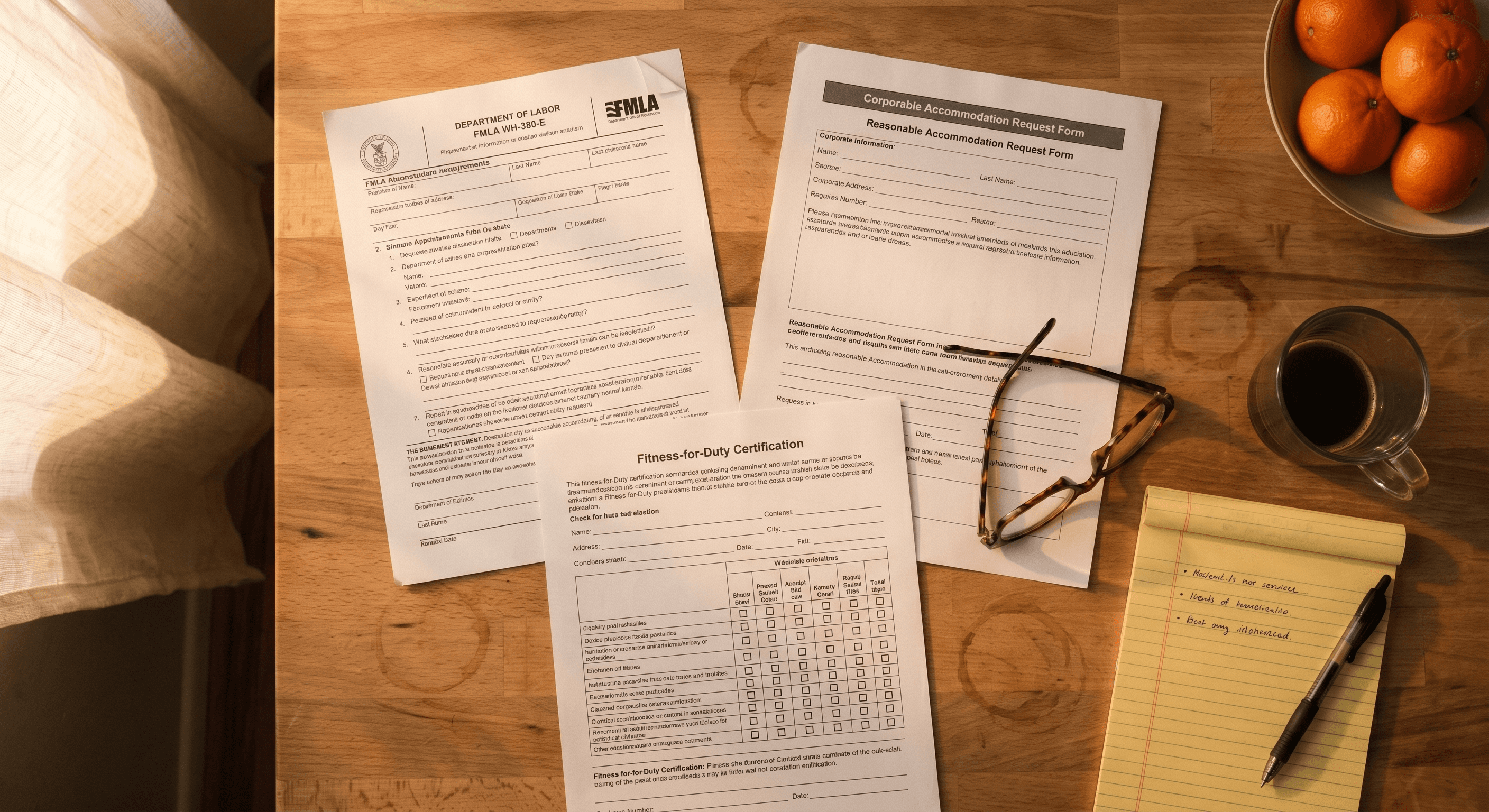
If you've requested an accommodation or asked about FMLA leave, you've probably noticed that HR doesn't just send one form. They send a packet, and the forms inside the packet have different names, different purposes, and different rules about who can complete them.
This causes a lot of avoidable confusion. Employees show up to a fifteen minute appointment with their primary care doctor, hand over a stack of paperwork, and walk out with everything checked "unable to determine" because the doctor never had time to engage with the underlying job description.
This guide is a plain-English breakdown of the most common forms employers use, what each one is asking, and which provider is the right person to complete it. Use it before you take anything to a clinician.
ADA accommodation request forms
Most large employers have an internal form for accommodation requests under the Americans with Disabilities Act. The names vary: "Reasonable Accommodation Request Form," "ADA Accommodation Application," "Request for Workplace Adjustment." The substance is similar across all of them.
These forms typically ask for four things. First, a general description of the impairment, which the EEOC's enforcement guidance explicitly says does not require a diagnosis label. Second, the major life activities that are limited. Third, the specific functional limitations relevant to the job. Fourth, the requested accommodation.
There is no single national ADA form. Some employers send a one-page document with broad text fields. Some send eight pages with a detailed grid of essential job functions to be checked off. Some don't send a form at all and simply ask your provider to write a letter. The format is the employer's choice.
Who can complete it: any "qualified professional" recognized by the EEOC, which includes psychologists, licensed therapists, social workers, occupational therapists, and medical doctors. For mental health conditions, a psychologist or other mental health clinician is usually the strongest choice.
For more on what this form should actually contain, see our explainer on what an ADA mental health accommodation letter should include.
FMLA medical certifications (WH-380-E and WH-380-F)
The Family and Medical Leave Act protects up to 12 weeks of unpaid, job-protected leave per year for a serious health condition (your own or a family member's). The DOL publishes official FMLA forms that many employers adopt directly: WH-380-E for the employee's own serious health condition, WH-380-F for a family member's.
These forms are different from ADA accommodation forms in a few important ways. They ask for the date the condition began and an estimate of how long it will continue. They ask whether the employee can perform any essential job functions and which they cannot. They ask about likely frequency of incapacity for intermittent leave. And they explicitly require the signature of a "health care provider," which the DOL defines to include licensed psychologists.
A common mistake: employees use the same documentation for both ADA accommodations and FMLA leave. They overlap, but they are not the same. ADA accommodations are about adjustments that let you keep working. FMLA leave is about time away from work. The functional limitations described should match the type of relief requested. For a deeper look at how these laws differ, see our FMLA vs ADA comparison.
Who can complete it: any FMLA-recognized health care provider, including licensed psychologists, MDs, DOs, nurse practitioners, physician assistants, podiatrists, dentists, clinical social workers, and others listed in the DOL definition.
Job description acknowledgment forms
These usually arrive attached to the ADA form. The employer provides a list of essential job functions, often pulled from the original job posting or the formal job description on file in HR. The form asks the provider to indicate, for each function, whether the employee can perform the function with or without accommodation, and if not, what accommodation would be needed.
These forms are the most labor-intensive part of the packet. A thorough provider will spend the better part of half an hour going through them line by line. A rushed provider will tick boxes in two minutes, and the resulting document is much weaker support if HR pushes back or the request is denied.
Who can complete it: same provider who is signing the underlying ADA accommodation form. Job description acknowledgments are not separate documents from a documentation-standard standpoint; they are the granular version of the same clinical opinion.
Fitness-for-duty certifications
Fitness-for-duty forms are used in two situations. First, when an employee is returning from FMLA leave and the employer wants confirmation that the employee can perform essential job functions. Second, when an employer has a legitimate, job-related concern about whether the employee can safely perform the work.
The EEOC has clear rules about when fitness-for-duty exams can be required. Employers cannot require them as a routine matter or as a condition of employment for everyone. They have to be tied to specific, observable concerns about job performance or safety, and they have to be limited in scope to those concerns.
For mental health conditions, fitness-for-duty forms are narrower than ADA accommodation forms. They focus on whether the employee can return to work, not on what accommodations are needed once they do.
Who can complete it: a licensed clinician with the relevant scope of practice. For mental health, that's a psychologist, psychiatrist, or other licensed mental health professional. The employer may also designate a specific evaluator or a panel.
Pre-employment medical inquiries
Worth mentioning briefly because they cause a lot of confusion. Under the ADA, employers cannot require a medical exam or ask disability-related questions before extending a conditional job offer. After the offer is made, they can require an exam, but the exam must be required of all entering employees in the same job category, and any information collected must be kept confidential.
If you're being asked to fill out medical paperwork before getting a job offer, that is usually not lawful, and you can read the ADA.gov employer resources page for an overview. We recommend consulting an employment attorney in that situation.
"Generic" HR forms with no clear name
Many employers, especially smaller ones, will send a single-page request that is something like, "Please have your provider write a letter explaining your condition and any work restrictions." There is no formal template. Some HR teams email this informally; some attach a Word document with a few prompts.
In these cases, the appropriate response is a properly formatted accommodation letter that hits the EEOC documentation requirements. The WashU-hosted resource on requesting accommodations covers what those letters should look like.
Who can complete it: same as the ADA form: a qualified professional with relevant expertise.
State-specific forms
A small number of states have their own disability documentation forms or required language for state-equivalent accommodation laws. California's FEHA requirements, New York's State Human Rights Law, and a few others sometimes generate additional paperwork in state-jurisdiction situations. These are usually layered on top of, not in place of, federal ADA documentation.
If your employer is sending you forms with state-specific letterhead or references, mention this when you book your evaluation so the provider knows to address state-specific elements.
How to figure out which forms apply to you
The simplest filter:
If you want time off from work, you're probably looking at FMLA and possibly short-term disability. The form will say "FMLA" or "Medical Certification" somewhere on it.
If you want adjustments to keep working (remote work, schedule changes, modified duties), you're looking at ADA accommodations. The form will say "Accommodation" or "ADA" somewhere on it.
If you're returning from leave, you're looking at fitness-for-duty.
If you want both leave and accommodations, you'll likely have both ADA and FMLA paperwork running in parallel.
The question of "do I need a diagnosis to complete these forms" comes up constantly. The short answer is no, you don't need a diagnosis label, but the underlying condition does have to be a recognized mental or psychological disorder assessed by a qualified provider. We've written a longer piece on whether you need a diagnosis to get an ADA accommodation.
Practical next step
Whatever forms you have, the path forward is roughly the same. Identify which forms apply, gather your job description, write a short summary of how your condition affects your work, and book an evaluation with a clinician who actually has time to engage with the paperwork.
If you have multiple forms (the FMLA plus an ADA form, or an ADA form plus a job description plus a fitness-for-duty), make sure your evaluator knows up front. Our Complete Support package is designed for exactly this situation: the standalone letter or one form plus up to two additional supplemental employer forms, all handled by the same provider so the answers stay consistent across documents.
For the actual mechanics of getting a psychologist to fill these out via telehealth, see our guide on accommodation form completion.
Written by the WorkWell Evals team. WorkWell connects employees with PSYPACT-licensed psychologists for ADA workplace accommodation evaluations. Available in 40+ states via telehealth. Learn more at workwellevals.com.