How to Get a Doctor's Letter to Work From Home

Last updated: 4/25/2026
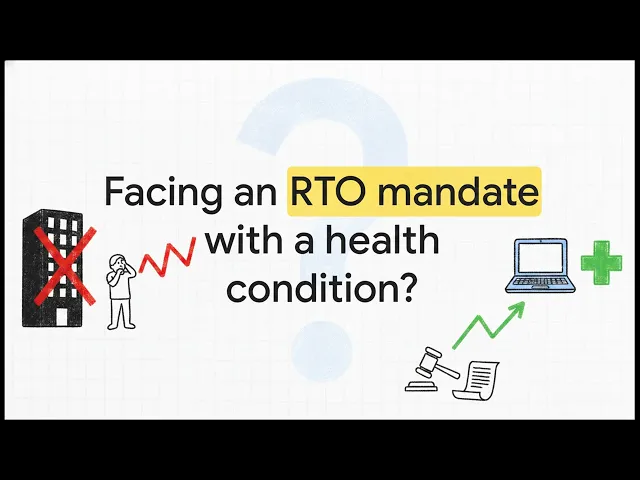
If your employer is requiring you back in the office and you have a mental health condition or chronic illness that makes that difficult, you may need a doctor's letter to formally request remote work as an accommodation under the Americans with Disabilities Act. The letter is the documentation your employer needs to consider your request through what the law calls the interactive process.
This guide walks through what that letter actually needs to say, who can write it, the difference between a "doctor's note" and an ADA accommodation letter, and how to get one without waiting months for an in-person appointment. For broader context on your rights, see our companion guide How to Request a Remote Work Accommodation Under the ADA.
A few things this guide is not: it's not legal advice, and it doesn't promise that your accommodation request will be approved. Accommodation decisions are made by your employer, not by your provider. What the letter does is put you in a position to make a credible, documented request.
What is a doctor's letter for working from home, exactly?
Two terms worth distinguishing. A "doctor's note" is the kind of brief note you'd get for a sick day. An ADA accommodation letter is a more formal document a qualified healthcare provider writes to support your request for a workplace accommodation. The two often get conflated.
For an ADA request to work from home, you need the second kind. The U.S. Equal Employment Opportunity Commission (EEOC) has specific enforcement guidance on what makes documentation sufficient. Per that guidance, sufficient documentation describes the nature, severity, and duration of the impairment; identifies the major life activities it limits; explains the extent of those limitations; and substantiates why the requested accommodation is needed.
A diagnosis label alone does not make documentation sufficient. The absence of one does not make it insufficient either. Our deep-dive on this is at Do You Need a Diagnosis to Get an ADA Workplace Accommodation?. What matters is the functional description — what your condition makes hard, and how working from home would address that.
This is why "I get headaches in the office" doesn't cut it but "the employee experiences anxiety symptoms that meet the criteria for a recognized clinical disorder, with functional impairments in concentration and stamina that are substantially mitigated by a controlled home environment" does.
Who can write the letter?
The EEOC recognizes a range of providers as appropriate sources for ADA documentation, not only medical doctors. Psychologists, licensed mental health professionals, therapists, nurses, occupational therapists, and other qualified providers can all provide documentation depending on your condition. The Job Accommodation Network (JAN), a service of the U.S. Department of Labor's Office of Disability Employment Policy, maintains additional guidance on which provider types are appropriate for which conditions.
Mental health conditions are generally best documented by a psychologist or licensed mental health professional. Chronic physical conditions are typically documented by the treating physician. Our companion piece Which Credentials Are Best for an ADA Accommodation Letter? goes deeper on the credential-condition match.
What matters more than credential type is whether the provider is qualified to assess your specific condition. A psychiatrist documenting a back injury or a chiropractor documenting major depression both look weak to an HR department. Match the provider type to the condition.
The provider also needs to be licensed in your state — or, for psychologists, authorized through the Psychology Interjurisdictional Compact (PSYPACT), which allows interstate telehealth practice across 42 states. We cover this in detail at What Is PSYPACT? Getting an Online Accommodation Evaluation in Your State.
START HERE
Where will you be located during your appointment?
Your physical location during the video call, not where your employer is based. Coverage is 40+ states. Opens our eligibility form at forms.workwellevals.com.
What should the letter include?
A strong ADA accommodation letter for remote work covers six elements:
Provider credentials and license information — full name, degree, license number, state of licensure or PSYPACT authorization
Provider-patient relationship — confirmation that the provider has evaluated the patient and is qualified to make the assessment
Description of the condition — the nature of the impairment, framed as a recognized clinical condition rather than just symptoms
Functional limitations — what major life activities the condition limits and how, focused on workplace impact
Recommended accommodation — that working from home (or hybrid, or schedule modification) would substantially mitigate the limitations
Duration and review — whether the accommodation should be ongoing or revisited
Notably absent from a well-written letter: a diagnosis code, specific medications, detailed treatment history. These violate medical privacy and aren't required for the employer's interactive process. Your employer needs to understand the impact of your condition, not its details.
For condition-specific examples of strong language, see our guides for anxiety, depression, ADHD, and PTSD. For chronic conditions, see Chronic Conditions and Remote Work Accommodations.
Once your letter is ready, you submit it to HR with a written request. Our ADA accommodation request form shows what that request should say.
How long does it take to get one?
Traditional in-person psychiatry typically has an 8-12 week wait for new patients in most metro areas, often longer. An existing primary care provider can sometimes write a letter within 2-3 weeks but often defers to specialists. Telehealth psychology offers same-week appointments commonly, with the letter typically delivered 24-48 hours after the evaluation. We have a more detailed timeline breakdown at How Long Does It Take to Get an ADA Accommodation Letter?.
The bottleneck for most people is finding a provider with availability. Telehealth has made this dramatically faster, especially through PSYPACT, which allows psychologists to evaluate patients across state lines.
How much should it cost?
Existing primary care providers can usually write a letter under your normal copay if they're willing to. Standalone evaluations by a psychologist typically run $150 to $400 depending on credential and time. WorkWell Evals charges $169 for a standard evaluation or $299 with employer follow-up support included. Full pricing comparison at How Much Does a Workplace Accommodation Evaluation Cost?.
Insurance generally does not cover ADA accommodation letters because they're considered administrative documentation, not medical treatment. This is true across providers.
What if your employer pushes back?
Even with strong documentation, your employer can deny the request, ask for additional information, or counter-propose. The ADA requires a good-faith interactive process, not automatic approval. We've written about this at length in Can My Employer Deny My ADA Accommodation Request? and our Medium guide Your Employer Denied Your Remote Work Request — Here Are Your Rights Under the ADA.
Common pushbacks and what they mean:
"We need more specific information." Your provider can submit clarification, but you don't have to disclose your full medical history. Stick to functional limitations.
"Working from home isn't reasonable for this role." The employer must explain why and engage in alternatives like hybrid work, schedule changes, or modified duties. See ADA Accommodation for Hybrid Work and ADA Accommodation for Schedule Changes for what to ask for.
"Other employees aren't allowed to." Past denials of others don't determine your case — your situation is its own assessment.
"We need a different provider type." If reasonable, accommodate. If they're trying to disqualify a perfectly valid provider type the EEOC recognizes, that's a flag.
If the conversation breaks down, you can file a charge with the EEOC. For situation-specific legal advice, consult a licensed attorney — this guide is informational. Our step-by-step playbook for denial situations is at Your ADA Accommodation Request Was Denied: A Step-by-Step Action Plan.
How WorkWell handles this
WorkWell connects you with a PSYPACT-authorized licensed psychologist via telehealth. We're not a clinical practice — we're a platform that handles the eligibility check, intake, and scheduling so the provider can focus on the evaluation. The provider you meet with makes all clinical decisions independently, including whether to issue a letter.
The standard process: complete the intake (about 15 minutes), book a 15-minute video consultation with the provider, and receive your letter within 24-48 hours if the provider determines it's appropriate. Standard evaluation is $169. The Complete Support Package at $299 includes employer follow-up support — useful if your HR department has additional questions or requires multiple rounds of documentation.
Ready to start? Check your eligibility — takes 2 minutes
Sources and further reading
U.S. Equal Employment Opportunity Commission, Enforcement Guidance on Reasonable Accommodation and Undue Hardship Under the ADA
U.S. EEOC, Depression, PTSD, & Other Mental Health Conditions in the Workplace: Your Legal Rights
Job Accommodation Network, Workplace Accommodations
U.S. Department of Labor, Maximizing Productivity: Accommodations for Employees with Psychiatric Disabilities
PSYPACT, State Coverage Map
Frequently asked questions
Can my regular doctor write a letter to work from home?
Yes, if they're qualified to assess your specific condition. For mental health conditions, a psychologist or licensed mental health professional is generally a stronger fit than a primary care provider.
How long is a doctor's letter for work from home valid?
There's no fixed expiration. Many letters specify a review period, often 6 to 12 months. Your employer may ask for updated documentation if circumstances change.
Will my employer ask for a diagnosis?
They can ask, but you're not required to disclose specific diagnoses to support an ADA request. Functional limitations are sufficient under EEOC guidance.
Does my employer have to approve my request if I have a doctor's letter?
No. The letter starts the interactive process — your employer may approve, deny, or counter-propose. Decisions are made through good-faith dialogue.
Written by the WorkWell Evals team. WorkWell connects employees with PSYPACT-licensed psychologists for ADA workplace accommodation evaluations. Available in 40+ states via telehealth. Learn more at workwellevals.com.